How Acids Change Your Skin vs. LED
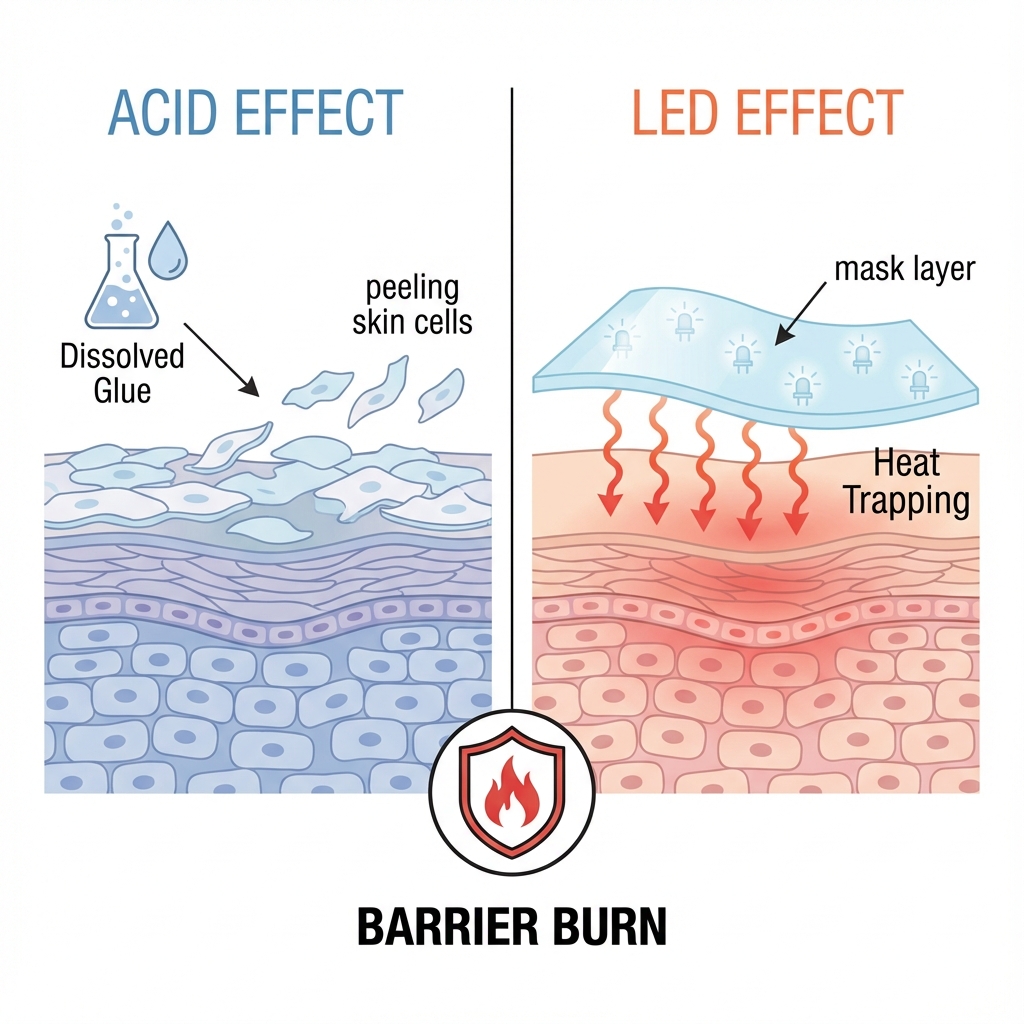
The conflict between acids and LED creates a "perfect storm" for irritation if not managed correctly:
Acid Mechanism (AHA/BHA)
- Dissolves the "Glue": Acids break down the bonds holding dead skin cells together, thinning the outer protective layer.
- Increases Permeability: With fewer dead cells, your skin becomes more permeable to everything—including heat and friction.
- Exposes Nerves: A thinner horn layer means nerve endings are closer to the surface, making them reactive.
LED Mechanism (Red/NIR)
- Anti-Inflammatory (Ideally): Red light signals cells to repair.
- Thermal Trapping: While the light is "cool", the mask itself is an insulator. It traps body heat and device warmth against the skin.
- Contact Friction: Masks sit directly on the skin. On acid-softened skin, this can cause physical irritation.
The Conflict: You are taking a skin barrier specifically thinned by acids and subjecting it to heat, occlusion, and light energy. This can tip "active skincare" into "barrier damage".
Red Card: When NOT to Combine
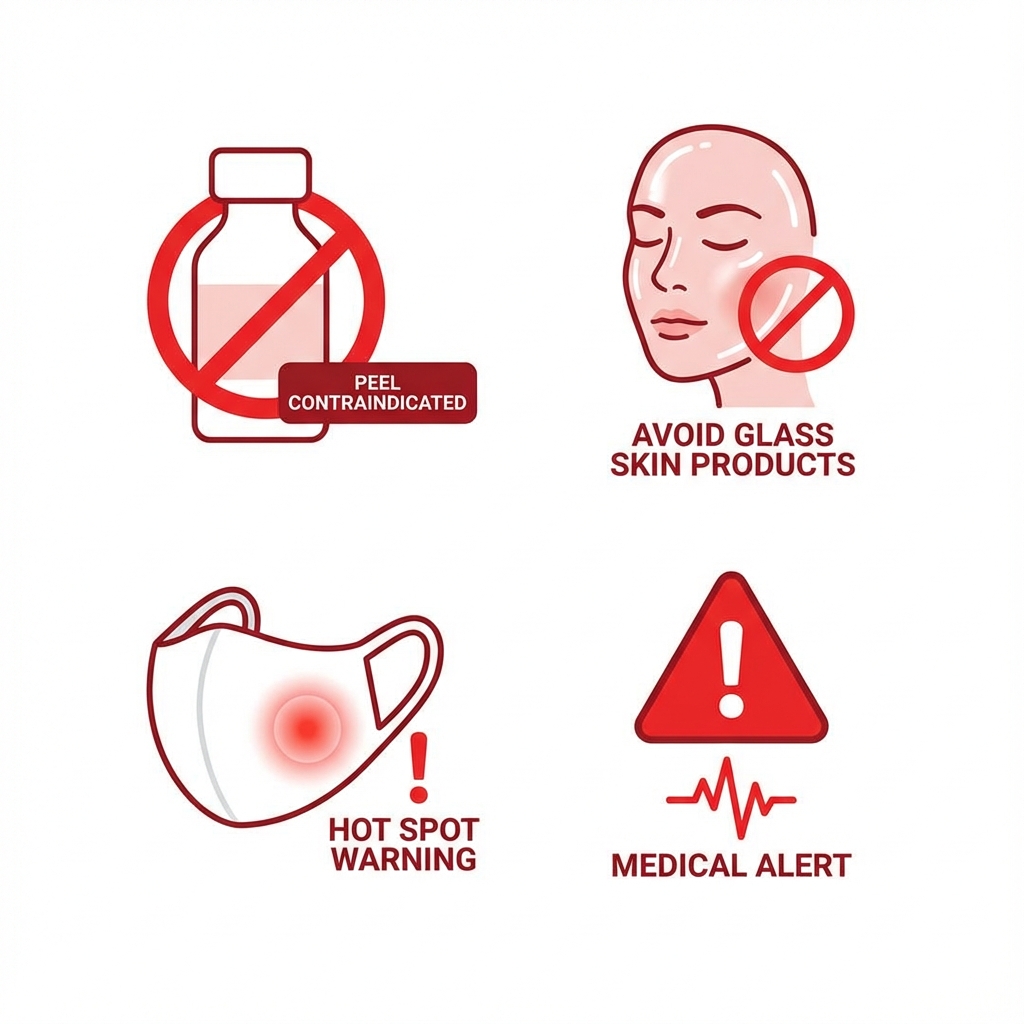
Avoid LED therapy completely (or strictly separate by 24-48 hours) if you fit these criteria:
- Medium-Depth At-Home Peels: Products like The Ordinary's 30% AHA peel. Do not use LED immediately after.
- Post-Professional Procedures: After microneedling, TCA peels, or laser (unless your clinic performs the LED immediately as part of the sterile treatment).
- Active Stinging: If your tonic or moisturiser stings when applied, your barrier is open. LED heat will worsen this.
- "Glass Skin" Over-Exfoliation: If your skin looks tight, shiny like plastic, and feels squeaky, it is compromised. Stop both acids and LED.
- Using Cheap/Unverified Masks: Masks with poor heat regulation can develop "hot spots". On acid-thinned skin, a hot spot can cause a rapid burn.
Green Card: When It Is Generally Safe
Combining exfoliation and light therapy can yield smooth, glowing results, provided you follow these safety rules:
- Gentle Acids Only: You use PHAs (Polyhydroxy Acids), Mandelic Acid, or Lactic Acid in low percentages.
- Limited Frequency: You exfoliate 1-2 times a week, not daily.
- Stable Barrier: Your skin feels comfortable, hydrated, and has no history of recent dermatitis.
- Cooler Devices: You use a panel (which sits away from the face) or a high-end mask known for heat dissipation (like CurrentBody).
- Correct Spacing: You check the "Safe Scheduling" patterns below.
Safe Scheduling Patterns
Don't guess. Use these templates to structure your week.
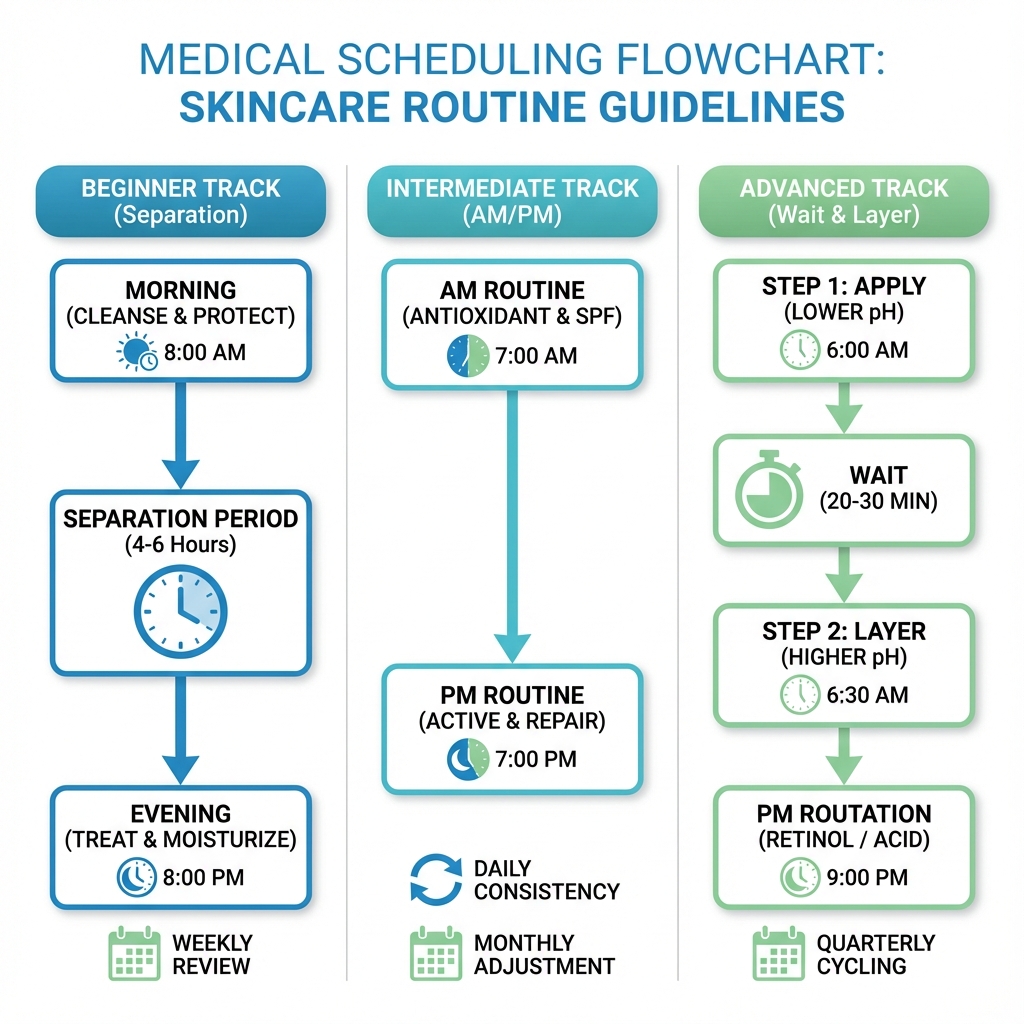
The "Separation" Method
Best for: New acid users, sensitive skin.
- Mon: Acid Treatment (No LED)
- Tue: Hydrate / Rest
- Wed: LED Mask (Clean skin)
- Thu: Hydrate / Rest
- Fri: LED Mask (Clean skin)
- Sat/Sun: Rest
Zero overlap risks.
The "AM / PM" Split
Best for: Daily LED users.
- Morning: Cleanse → LED Session → SPF.
- Evening: Cleanse → Acid Toner → Serum.
Light in the morning, acids at night.
The "Wait & Layer"
Best for: Resilient skin, gentle acids only (e.g. PHA).
- Step 1: Cleanse.
- Step 2: LED (10 mins) on bare skin.
- Step 3: Wait 10 mins for skin to cool.
- Step 4: Apply mild Acid.
Never do Acid THEN LED.
Fail Patterns: Real-World "Horror Stories"
The "Glycolic Burn"
The Mistake: Using a strong 7% Glycolic toner and immediately putting on an LED mask.
The Result: Deep, itchy burning sensation and redness that lasted days. The mask trapped the acid's potential to irritate.
The "Salicylic Swell"
The Mistake: Doing a strong BHA peel for acne, then using Blue LED to "kill bacteria" right after.
The Result: Extreme dryness and swelling. Both treatments dry the skin; together they nuked the moisture barrier.
The "Daily Grind"
The Mistake: Daily acid toner + Daily LED use.
The Result: Chronic low-grade stinging. The skin never gets a "rest day" to rebuild its lipids.
Device Selection for Acid Users
If you regularly exfoliate, your choice of device matters more. You want minimal friction and minimal heat.
Heat RiskAvoid Cheap Amazon Masks | ||||
|---|---|---|---|---|
| Heat accumulation | Low (silicone breathes) | Moderate (rigid shell) | None (air gap) | High (active heating risk) |
| Friction on exfoliated skin | Gentle contact | Pressure points (straps) | Zero contact | Poor fit / Rubbing |
| Acid user safety | High (with caution) | Moderate | Very High | Low (burn risk) |
How This Guide Was Created
We use Perplexity to gather real-world user patterns from Reddit and YouTube dermatologists, cross-checking all advice against UK dermatology clinic guidance. We analyse device heat issues and strap-pressure failures to prioritise safety over marketing claims.
Acids & LED FAQs
Can I use glycolic acid and an LED mask on the same night?
Ideally, no. Glycolic acid is a small molecule that deeply penetrates and thins the stratum corneum. Combining this with the heat and occlusion of a mask can trigger immediate flushing or a 'burn-like' reaction. Save them for separate nights.
How long should I wait to use LED after a professional peel?
Always follow your clinician's specific advice. Generally, for superficial peels, wait 3–5 days until all stinging subsides. For medium-depth peels (like TCA or microneedling), wait 7–14 days until the skin barrier has fully re-epithelialised.
Are PHAs safer to use with LED?
Yes, but caution is still needed. Polyhydroxy Acids (PHAs) are larger molecules and less irritating, but they are still exfoliants. If you have sensitive skin, separation is still the safest policy.
Is salicylic acid (BHA) okay with blue light for acne?
This is a common combo for acne, but be careful. Blue light and Salicylic acid both dry the skin. Using them together daily can dehydrate the barrier, leading to more oil production and breakouts. Use the LED on clean skin, and perhaps use BHA as a spot treatment rather than all over.
What if my face stings during the session?
Stop immediately. Stinging is a sign that your barrier is compromised and the nerve endings are hypersensitive. Wash your face with cool water, apply a simple barrier cream, and skip both acids and LED for at least 5 days.
Sources & Citations
- Dermatology Clinic Protocols: Guidelines on avoiding LED immediately post-peel.
- r/SkincareAddiction Analysis: 'The Glycolic Burn' patterns from overheating sensitized skin.
- Journal of Clinical Dermatology: Effects of AHAs on stratum corneum thickness and sensitivity.
- Device Safety Reports: Hot spot analysis in budget LED masks vs. medical-grade silicone.
Found Your Routine?
If you use acids, we strongly recommend FDA-cleared masks with proven temperature regulation, or non-contact panels.
Medical Disclaimer: GlowLab does not provide medical care. LED masks and skincare actives may interact unpredictably for sensitive users. Always consult a dermatologist if you use prescription actives (tretinoin, azelaic acid, antibiotics) or have a skin condition.